
“…when it is time for you to say goodbye to your family, or when it is time for a dear one to say goodbye to you, the time invested in making memories will eclipse everything else. In an age obsessed with productivity and delayed happiness, this reflection strikes with painful force. Careers, ambitions, money, prestige…
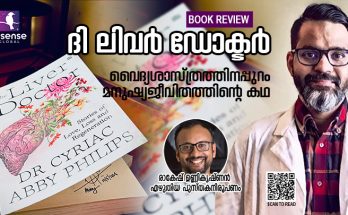
There are books written by doctors that teach medicine, books that explain disease, and books that chronicle clinical brilliance. The Liver Doctor: Stories of Love, Loss and Regeneration by Dr. Cyriac Abby Philips belongs to none of these categories alone. It is not merely a medical memoir, nor simply a collection of patient stories. It is, at its heart, a deeply humane meditation on grief, regret, addiction, healing, and the unbearable privilege of standing at the edge of another person’s suffering.
Dr. Cyriac Abby Philips known widely as “The Liver Doc” is not only a hepatologist but also one of India’s most vocal advocates for evidence-based medicine, particularly in the area of liver disease and herb-induced liver injury. Through years of research and public engagement, he has consistently warned against unscientific medical claims and the dangerous assumption that “natural” automatically means safe. His work has highlighted how unregulated herbal formulations, including certain Ayurvedic preparations and so-called immunity boosters, can trigger devastating liver failure, especially in vulnerable patients. Yet, in this book, the physician-scientist steps aside for something more intimate: the vulnerable human being behind the white coat.
What emerges from The Liver Doctor is startling. Doctors, contrary to popular imagination, do not become immune to death simply because they witness it repeatedly. If anything, repeated exposure to suffering only deepens the invisible scars they carry. Abby writes with startling honesty about this burden, not as a heroic physician above grief, but as a man repeatedly broken and rebuilt by the people he could not save.
Perhaps nowhere is this vulnerability exposed more painfully than in the story of Juniper, his beloved dog. In many medical memoirs, animals are symbols of comfort; here, Juniper becomes the embodiment of regret. Her death is not narrated sentimentally but devastatingly, through the helplessness of someone accustomed to treating illness but powerless before personal loss. Abby mourns not merely the death of a pet but the unbearable realization that he was not there when she needed him most. He wonders what she saw in her final moments, alone among strangers, far from the person who raised her.
From Juniper comes one of the book’s most profound truths: when it is time for you to say goodbye to your family, or when it is time for a dear one to say goodbye to you, the time invested in making memories will eclipse everything else. In an age obsessed with productivity and delayed happiness, this reflection strikes with painful force. Careers, ambitions, money, prestige—all collapse before the simple human need to have loved deeply and been present when it mattered.
The tragedy of Juniper also quietly introduces another recurring theme of the book: the brutality of healthcare inequality. Abby writes of a country where life-saving treatment remains unaffordable for many families, where impossible choices become routine. Should parents save their children’s future or prolong a loved one’s life on a ventilator? Should families plunge into irreversible debt for a slim chance of survival? It is a grim reality that medicine often confronts but society frequently ignores. Disease, the book repeatedly reminds us, is profoundly democratic in whom it strikes, but healthcare rarely is.
Yet The Liver Doctor is not a book about surrender. One of its most moving observations is that the art of clinical medicine is not about giving up. Doctors, Abby argues, are not merely healers of disease but guides through uncertainty. They teach patients and families how to navigate trials that may end in recovery or death. Equally, physicians must learn to live with heartbreak themselves, to absorb losses without becoming emotionally numb.
This idea reaches extraordinary emotional depth in the story of Harish and Nalini. Harish, critically ill with liver disease and multiple organ failure, lies suspended between life and death while Nalini struggles to accept the inevitable. The moral conflict that unfolds is devastating in its complexity. Harish’s parents wish to let him fade peacefully in induced sleep, untouched and dignified. Nalini, unable to imagine a future without him, asks a question that transforms medical ethics into something painfully human: “There would never be a part of him with me. Please doctor, can you arrange to retrieve his sperm for me to have his child?”
It is impossible to take sides here, and perhaps that is precisely the point. No one is entirely right, and no one entirely wrong. Grief rarely obeys logic. Love, when cornered by death, becomes desperate, irrational, and heartbreakingly sincere. Abby refuses to moralize. Instead, he observes the emotional architecture of suffering with compassion. The chapter culminates in one of the most haunting reflections in the book: because to die in love is a great thing of beauty.
The Harish–Nalini story also contains one of the book’s greatest insights into the emotional labour of doctors. Abby confesses to what he calls a “terrible habit”: repeatedly conducting self-stress tests. When patients are critically ill, he imagines himself in their place; or worse, imagines his own wife and children facing the same suffering. What would happen if he were suddenly gone? What would grief do to those he loved? This emotional projection is not weakness; it is empathy stretched painfully thin.
In one remarkable passage, Abby writes that a critically ill cirrhosis patient in multiple organ failure marks the moment where the role of medical science ends and the act of humanism begins. It is then, he says, that doctors hang up their white coats and begin standing in the shoes of their patients’ families. Treatment becomes secondary to presence, explanation, comfort, and dignity. This distinction is profoundly important. Medicine may not always cure, but humanity can still heal something intangible in suffering.
The book repeatedly reminds us that disease is the ultimate equalizer. It does not negotiate with happiness, wealth, intelligence, faith, or future plans. It arrives uninvited and rewrites lives overnight. Abby powerfully argues that life can shift from ordinary to catastrophic in an instant and therefore the present matters infinitely more than our imagined tomorrows. Live fully today, he urges: through overdue conversations, forgotten greetings, postponed trips, and reconciliations delayed for too long.
The emotional centre of the book, however, may lie in its exploration of addiction. Through patients like Nobin, Abby dismantles simplistic understandings of alcoholism. Nobin had reclaimed his life after quitting alcohol. He and his father rebuilt their relationship, opened a modest food business, and rediscovered dignity. For a while, life returned. Then his father died unexpectedly.
Grief opened the old wound.
Nobin began drinking again. Slowly at first, then destructively, eventually to death. It is one of the book’s cruelest lessons: recovery is rarely linear, and addiction is not merely a moral failure but often grief searching desperately for anesthesia. Abby writes not with condemnation but sorrow. Alcohol, he suggests, preys on the vulnerable mind precisely when life becomes unbearable.
The book’s discussion of alcohol deserves serious attention, particularly because it cuts through decades of misinformation. For years, popular culture repeated the comforting myth that moderate alcohol consumption might benefit heart health. Abby revisits the evidence with rigor, discussing studies that have dismantled this narrative. Research increasingly suggests that the supposed cardiovascular benefits of low alcohol consumption are heavily confounded by lifestyle factors; when properly adjusted, even modest drinking may increase long-term health risks, including cancers and cardiovascular harm. Recent studies suggest there is effectively no safe level of alcohol consumption that benefits human health.
Alcohol’s damage extends far beyond the liver. It shrinks brain volume, erodes emotional regulation, impairs judgment, worsens psychiatric vulnerability, and gradually alters personality. Every drink, Abby argues, disguises dependence as pleasure.
His line “If alcohol is your friend, you don’t need enemies” is spot on. Alcohol rarely destroys lives dramatically at first. It enters socially, disguising itself as companionship, celebration, relief, adulthood, masculinity, confidence, or grief management. Then it quietly corrodes relationships, finances, careers, health, memory, and self-respect. People do not enjoy alcohol as much as alcohol gradually begins to enjoy the people consuming it, feeding parasitically on rationality, logic, and self-control. It becomes the architect of denial.
This tragedy is painfully visible in the story of Paul and Celine. Paul suffers from severe alcohol use disorder and repeatedly spirals back into destruction despite treatment. Perhaps the most morally unsettling moment in the book comes when Celine says: “Let him remain sick. If he gets better, he goes back to drinking and we lose money.” At first glance, the statement shocks. Yet Abby refuses to vilify her. Poverty, exhaustion, domestic violence, financial desperation, and repeated betrayal had changed love into survival.
After Paul dies, Celine visits Abby carrying laddus on his birthday.one from her, two from their daughters. The absent fourth laddu, the one Paul could never offer himself, becomes an extraordinary symbol of unfinished grief.
If The Liver Doctor argues passionately against anything, it is not tradition but dangerous medical irrationality. Abby’s criticism of alternative and unscientific treatments emerges not from ideological hostility but repeated encounters with preventable tragedy. One of the book’s most devastating examples is Nasreen, a six-year-old child who developed acute liver failure after being given homemade giloy herbal juice to treat a persistent cough when syrups had failed. A child’s life unravelled because “natural” was mistaken for harmless. Abby later appealed publicly and even wrote to the Prime minister’s office and Ayush ministry urging to place warnings regarding unsafe herbal products, particularly those linked to liver toxicity. Evidence increasingly shows that herb-induced liver injury is not rare, and substances such as giloy have been implicated in severe immune-mediated hepatitis and liver failure.
Then there is Amal, the sixteen-year-old who dreamed of returning to football after a liver transplant who is another victim of harmful herbal remedies. Saikrishna, only nineteen, suffered severe liver injury after consuming unregulated herbal formulations. Though medicine managed to save her life, survival came with consequences; irregular menstrual cycles, lingering health complications, and the quiet anxiety of what future illnesses might still emerge. One is left repeatedly asking: what if scientifically tested medicine had been trusted earlier? What if fear had not delayed care? What if Haneefa had not been frightened away from evidence-based treatment? These questions haunt the reader because they expose an uncomfortable truth: pseudoscience does not merely misinform; sometimes, it kills.
To criticize alternative treatment, however, is not to dismiss all traditional knowledge. The book argues for something far more reasonable: evidence. If a treatment works, it should withstand scientific scrutiny. If it fails or causes harm it must be questioned. Compassion without evidence can become cruelty disguised as hope.
Equally compelling is Abby’s argument that medicine is not algorithm alone. A significant part of clinical medicine is intuition, not mystical instinct, but pattern recognition sharpened by experience, repeated exposure, and hard-earned clinical wisdom. Doctors often know something is wrong before investigations fully reveal it. Good medicine lies not only in protocol but in listening carefully to the silent signals that disease leaves behind.
Among the book’s most unforgettable moments is the story of the seventeen-year-old daughter who pleaded before the Kerala High Court to donate part of her liver to save her father. It is impossible to read such stories and remain emotionally untouched. Likewise, Abby quotes Fyodor Dostoevsky who wrote that the death of a child is perhaps the greatest reason to doubt the existence of God, a statement less theological than profoundly human. Few experiences destabilize meaning itself more completely than watching a child die.
Scattered throughout the book are reminders that courage is not loud. Julius Caesar’s quote, “No one is so brave that he is not disturbed by something unexpected” echo through the lives of patients and doctors alike.
Perhaps that is why The Liver Doctor should be required reading for medical students. Not because it teaches hepatology, but because it teaches humility. Medicine is not only diagnosis and pharmacology; it is uncertainty, grief, ethics, exhaustion, and impossible conversations. It teaches future doctors that patients are stories before they are cases, families before they are attendants, and human beings before they become diagnoses.
More importantly, it teaches that doctors themselves are not machines. They break. They grieve. They carry ghosts home.
In the end, The Liver Doctor lingers because it is not really about the liver. It is about what illness reveals about love, memory, addiction, regret, and human frailty. It asks difficult questions without easy answers. It challenges magical thinking while fiercely defending compassion. And it reminds us, with painful tenderness, that in the final accounting of life, what matters most is rarely achievement or wealth, but whether we showed up for one another before time quietly slipped away.